Chris Riddell is chatting live to Viv about “Wizard Work”, the stategic family game about magical job opportunities designed by Kevan Davis and illustrated by Chris.
There will be live wizard drawing.

Beautiful card games.

Chris Riddell is chatting live to Viv about “Wizard Work”, the stategic family game about magical job opportunities designed by Kevan Davis and illustrated by Chris.
There will be live wizard drawing.

From Rough to Ready.
Let me show you the prototypes for our first card game, Wizard Work. The finished deck is a beautiful thing, with intricate ink and watercolour illustrations by Chris Riddell. But, as is proper, it started out as a bunch of paper scraps and a spreadsheet.
To begin with, Kevan Davis invented the game and did all the required maths. In the game, you get to sit in a pub and recruit wizards to do assorted jobs in a land of fairytales. The jobs have diverse requirements, and the wizards have diverse abilities when it comes to casting spells, potions, dealing with technology and straight-up fire. Kevan figured out the numbers needed on the cards, and randomised a bunch of wizardy names so we could make our first paper prototype.
We wanted the game to feel narrative, so I did a quick doodle on each card to represent the stats with some character that might pass for a wizard in the job market.
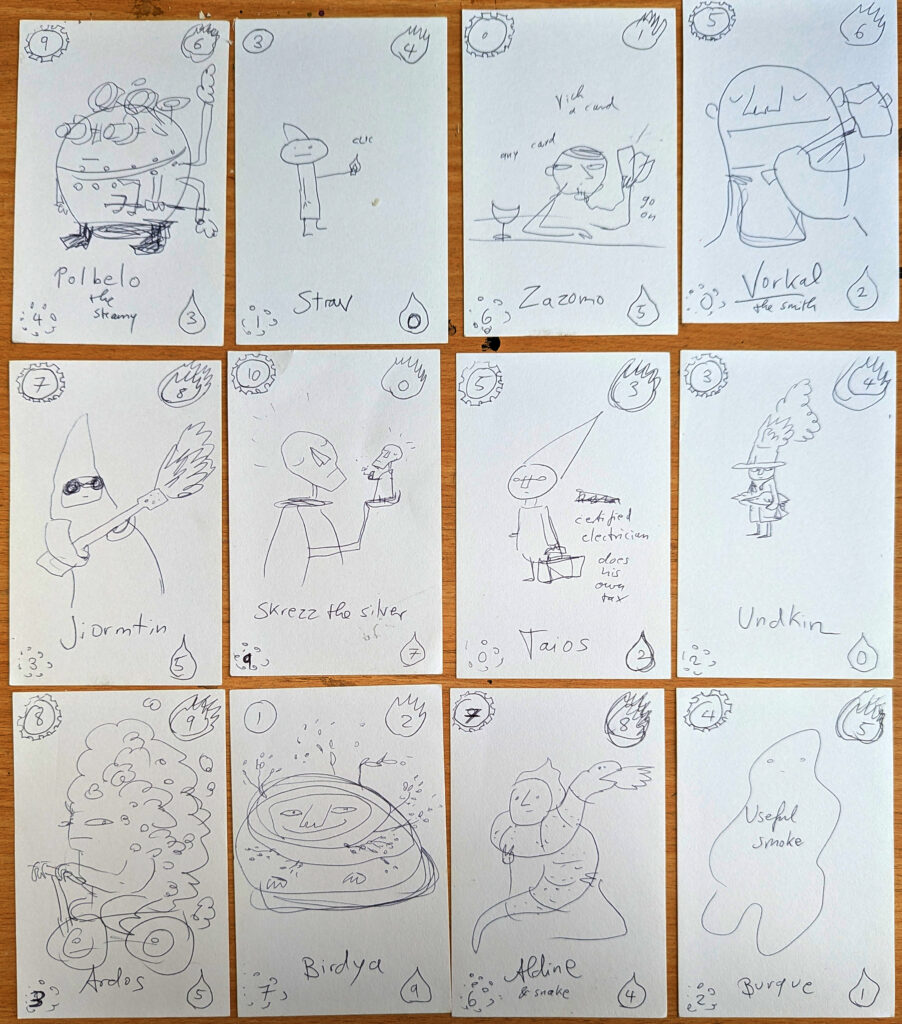
I don’t have the full set of cards any more – I remember there was one guy whose magic power was entirely contained in a vacuum cleaner, and another applicant was just a baby named “The Baby” (child labour seemingly being largely unregulated in fairytales, or maybe the magic power of The Baby was employability).
We tested this one a lot with friends – out in the park, because covid restrictions were still very much on. We got quite fond of those shonky wizards, but eventually, they had to go.
When the game was ready to illustrate, Chris drew a set of new wizards. He made them up himself from scratch and named them.
We tested again with them and I made notes and scribbled all over them. The main idea was to keep narrative hooks in play, so after assigning each character a set of numbers we thought about how to make them more obviously connected to their abilities, and how to encourage a bit of storytelling in other ways.


Chris redrew the lot from scratch, adding more narrative detail (not necessarily the detail I suggested, which is good, there would be more vaccum cleaners in this game and fewer airships else) and we tested again. The new wizards did a fine job, and we carried on designing the cards and the rulebook.
That’s when John Peacock came in, our graphic designer.
All I have to show for my part in the card design is a drawing that seems to explain SOMETHING.

Fortunately John is Very Good At This Kind Of Thing, and after over a decade of dealing with my roughs for many projects he also understands Viv quite fluently.
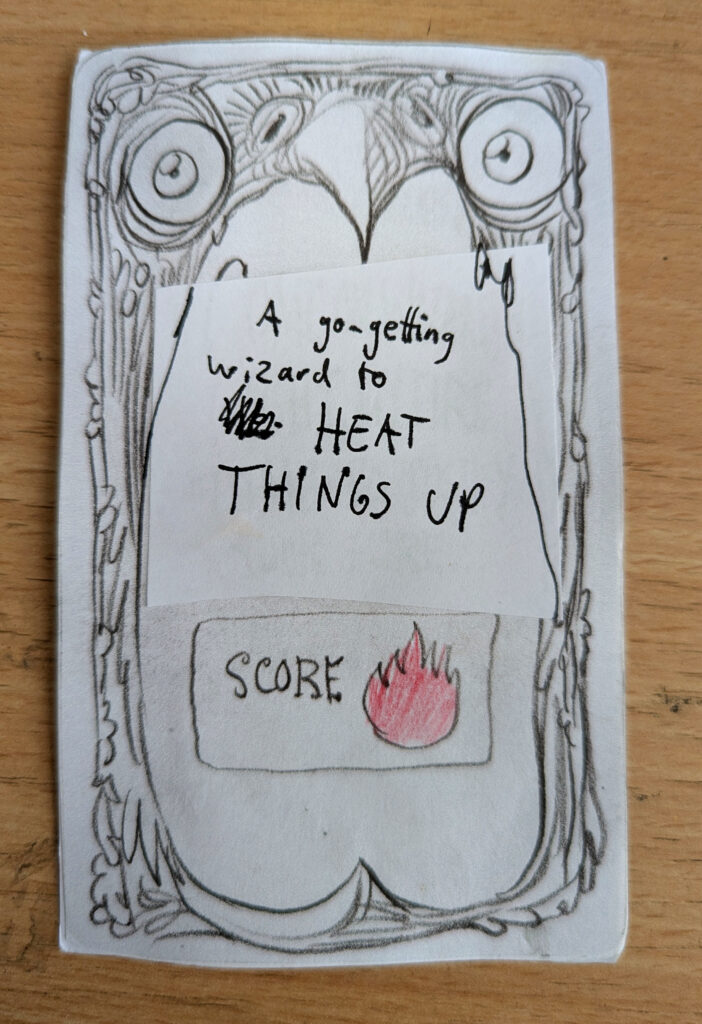
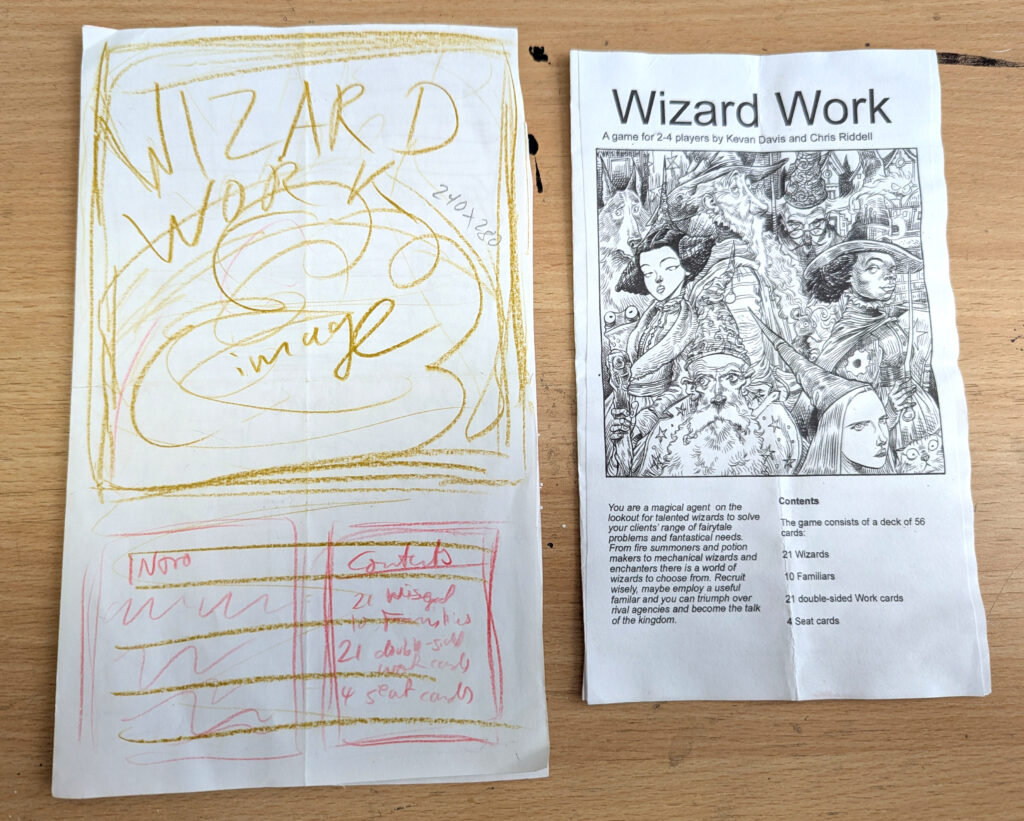
Chris hand-painted a final full-colour set of wizards. John fitted them onto the cards, which involved adjusting some colours to not interfere with the game-play and poking them about gently to not obscure the corner symbols, that kind of thing.

Was there more work? There was more work.
Chris wrote and illustrated a whole load of job ads. We shuffled numbers, made and tested version after version. Ivory Graphics, the excellent printing company we work with, made a final (and then a FINAL final) prototype to test and test again before it went to press for real.
You get the idea. It starts with a bunch of scraps and a spreadsheet, and after a lot of work and wizardry it ends up kind of… magical.


By now, we are working on a bunch of new games.
I’ll tell you about them soon!
